
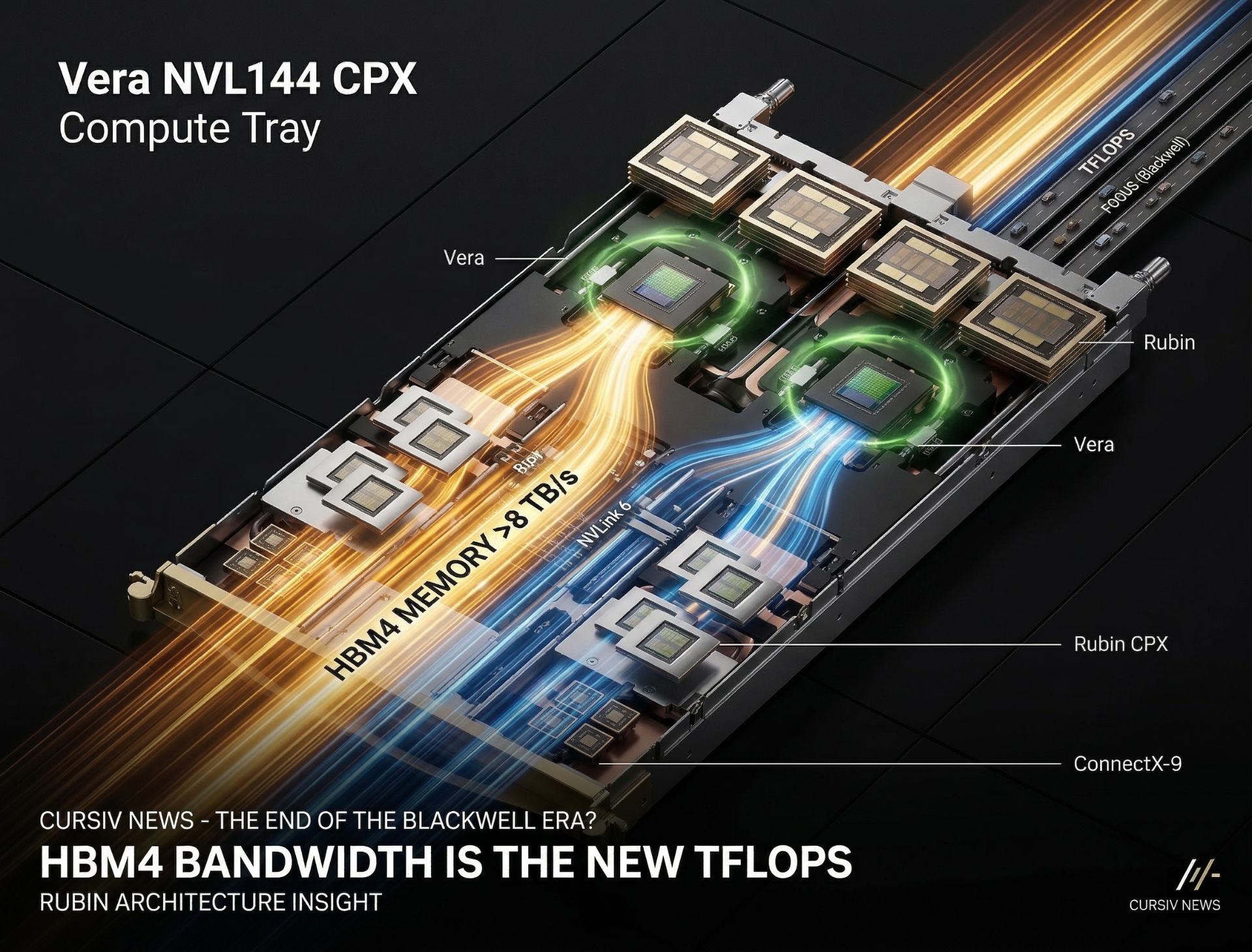
NVIDIA Unveils Rubin Architecture: The End of the Blackwell Era?
At a global conference held on Tuesday, NVIDIA disclosed the first technical details of the Rubin architecture — the direct successor to the Blackwell line, which is still being deployed across data centres worldwide. The announcement, earlier than the market anticipated, reignited a question that has been circulating in closed-door conversations among infrastructure engineers: has the AI arms race reached a point where hardware shipped yesterday is already obsolete on arrival?
The short answer is: not exactly. But NVIDIA is clearly not waiting for the market to discover Blackwell’s limitations on its own before positioning the next step.
What Is the Rubin Architecture?
Rubin is the code name for NVIDIA’s next-generation GPU family, with a projected launch in the second half of 2026. According to the company, the architecture was built from scratch with a single objective: maximising energy efficiency during the inference phase — the moment when an already-trained AI model responds to a real-time query.
The numbers presented by NVIDIA are significant:
- 4x superior energy efficiency compared to the Blackwell B200 for inference workloads on models with more than one trillion parameters.
- Native support for HBM4 memory (fourth-generation High Bandwidth Memory), with aggregate bandwidth exceeding 8 TB/s per GPU.
- A new NVLink 6 interconnect capable of linking up to 576 GPUs in a single fabric with inter-GPU communication latency below one microsecond.
But this is where the analysis becomes more interesting — and less obvious.
The Real Bottleneck: HBM4 vs. HBM3e
The dominant narrative in the technology press has continued to focus on TFLOPS (teraflops per second), the classic metric for a GPU’s raw computational speed. This is a framing error. For large-scale language models in production, memory bandwidth is the real bottleneck — not processing power.
Here is why:
A model such as GPT-4 or Gemini Ultra has hundreds of billions to trillions of parameters stored in memory. Each time the model generates a token in a response, the GPU must load large blocks of those parameters from memory into the processing cores. If the “highway” between memory and cores is narrow — that is, if bandwidth is low — it does not matter how fast the cores are. They will sit idle, waiting for data to arrive.
It is the equivalent of installing a Formula 1 engine in a car stuck in traffic.
| Specification | HBM3e (Blackwell B200) | HBM4 (Rubin) |
|---|---|---|
| Bandwidth | ~4.8 TB/s | >8 TB/s |
| Capacity per Stack | 36 GB | 48+ GB |
| Interface Generation | 1.2 Tbps/pin | ~1.8 Tbps/pin |
| Energy Efficiency | Baseline | ~40% improvement |
HBM4 is not an incremental update. It represents a generational shift that directly addresses the primary bottleneck of the current AI infrastructure stack — and NVIDIA is positioning Rubin to be the first platform to exploit it at data-centre scale.
The Market Strategy Behind the Announcement
Revealing Rubin while Blackwell is still being shipped is not an accident. It is a deliberate move with at least three objectives:
1. Lock major customers in for another two years. Microsoft, Google, Amazon and Meta all build their AI infrastructure strategy around 18-to-24-month capital expenditure cycles. By exposing the Rubin roadmap now, NVIDIA is effectively saying: “The next upgrade will reach you before the current one is fully depreciated.” This paralyses any serious attempt to diversify toward AMD or proprietary silicon.
2. Suffocate competitors in the inference segment. AMD, with its MI300X series, had gained ground by offering superior HBM memory capacity compared to NVIDIA’s previous generation. With HBM4 and a 4x inference efficiency advantage, NVIDIA closes that competitive window before it translates into meaningful market share erosion.
3. Reframe the energy conversation as an advantage, not a liability. AI data-centre power consumption has become a critical political and logistical problem. By positioning Rubin as “4x more efficient”, NVIDIA turns its next product into a corporate sustainability argument — a differentiator of growing importance in purchasing decisions made at board level.
What Infrastructure Buyers Should Do Right Now
This is the practical question for engineering teams that are actively specifying AI clusters for 2026 and 2027.
The answer is not binary. Blackwell remains the best available choice today for model training — the computationally intensive process of building a model from scratch. The raw TFLOPS scale of the B200 is still difficult to beat for that specific workload.
Where Rubin changes the calculation is in production inference infrastructure: the massively scaled service that must respond to millions of requests per day with low latency and high throughput. If the plan is to scale an AI product to real users in 2027, sizing clusters around Blackwell for that use case may be the wrong decision.
The practical cutoff: Training in 2025–2026 → Blackwell. Inference infrastructure for 2027+ → wait for Rubin.
The Energy Problem Nobody Wants to Solve
Beneath all the enthusiasm of the announcement, there is a question that no NVIDIA slide answers: where does the energy come from?
A 576-GPU Rubin cluster on NVLink 6, even at 4x superior efficiency, will still consume tens of megawatts continuously. Oracle, Microsoft and AWS are currently building data centres that require direct connections to the electricity grid at the scale of industrial substations. Competition for access to cheap, reliable, low-carbon power is becoming as strategically critical — or more so — than competition for access to chips.
Rubin solves the efficiency-per-watt problem. It does not solve the problem of available watts.
That is, perhaps, the next frontier that NVIDIA will need to help address — or that will create space for an entirely different type of player to emerge. The companies that solve energy at scale may end up holding as much leverage over the AI industry as the companies that currently manufacture the silicon.